

SPACEGENES


01 / The challenge
The Problem of Isolation.
The "Invisible" Risk.
Operational Friction.

02 / The strategy
The "Plus" Factor: Identifying Non-Linear Risk
I architected the Synergy Detection Engine to solve a specific biological blind spot: when the combined effect of radiation and microgravity is significantly greater than their individual sums.
The Logic: I translated a complex biological hypothesis into a functional UI requirement:

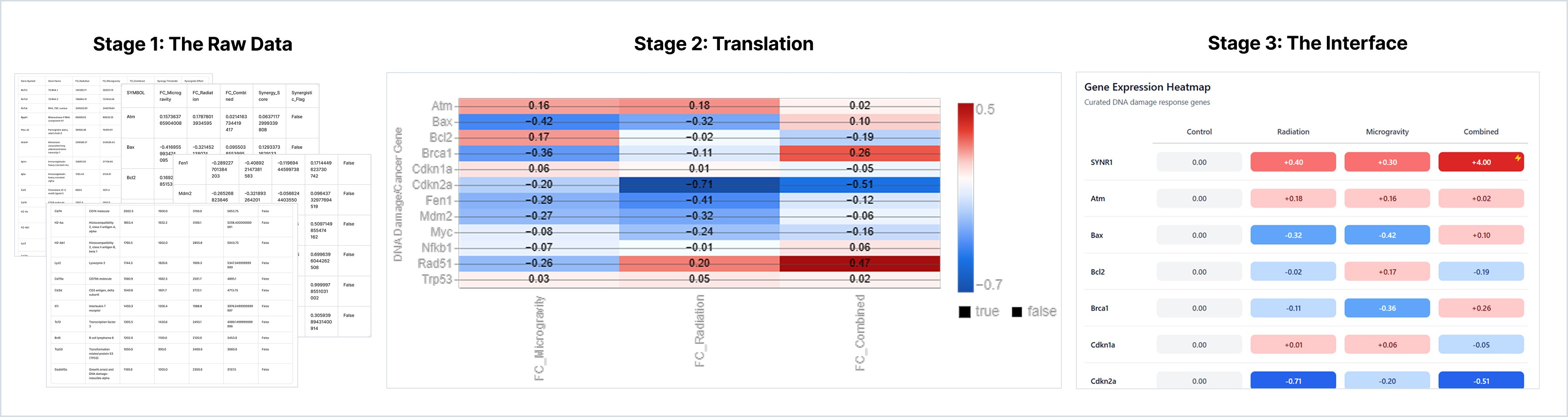
The Translation: I acted as the bridge between NASA’s OSD-288 raw datasets and the end researcher, ensuring that high-risk molecular pathways (like TP53 and BRCA1) were surfaced instantly rather than buried in CLI scripts.
Image/
From Script to System:
I developed a "Human-in-the-loop" workflow to accelerate the transition from raw NASA GeneLab data to a high-fidelity interface. This allowed for rapid iteration on the Synergy Calculator while maintaining strict scientific accuracy.
Image/
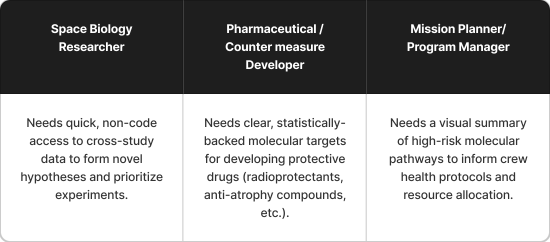
Architecture of an MVP:
Before moving to high-fidelity design, I mapped the functional requirements for three distinct user types: Researchers (Discovery), Drug Developers (Targeting), and Mission Planners (Safety). This ensured the platform solved for both deep science and operational speed.
03 / The execution
⚡ The "Synergy Bolt":
I introduced a specific visual signifier (The Bolt) to flag genes that met the synergy threshold. This allows a mission planner to identify a "red flag" gene in under 5 seconds.
Interactivity:
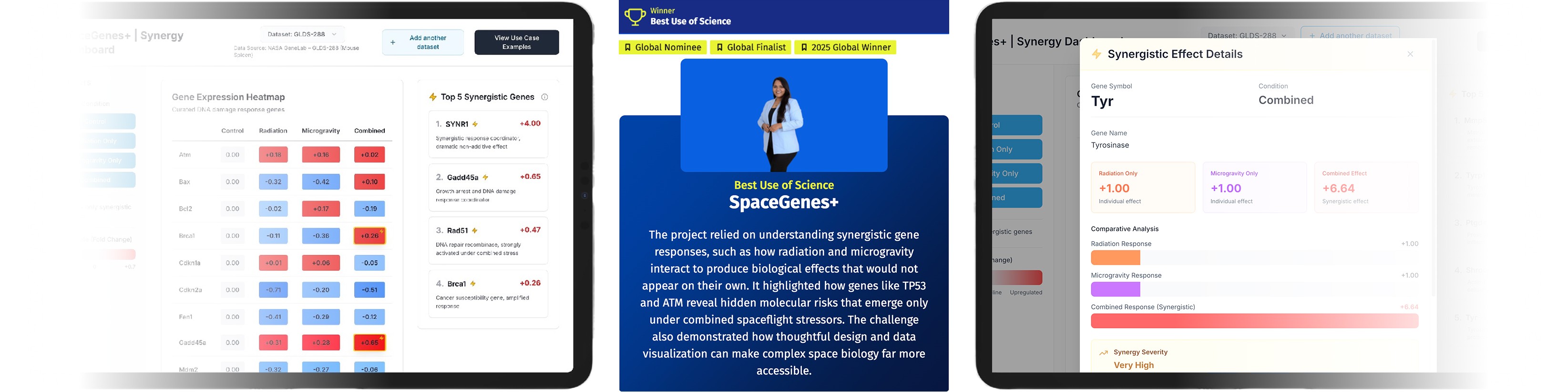
Every data cell is a gateway; hovering reveals the exact Fold Change (FC) value and the specific GeneLab Study ID, ensuring the tool remains a "Source of Truth."
Image/
The Scientific Command Center:
This high-performance interface transforms raw RNA-seq data into a navigable discovery tool. I integrated the Synergy Engine directly into the UI, using "Synergy Bolts" to prioritize high-risk genes (like TP53) and reducing the time-to-insight from hours of manual calculation to near-instant visual detection.

Image/
Designing for Scale:
The framework was architected to ingest any OSD (Open Science Data) dataset, transforming the project from a single-mission tool into a universal platform for space and terrestrial health research.

04 /

05 / Reflections

Next Project

Redesigned a fertility AI platform after discovery research revealed clinicians were ignoring the AI entirely. Pivoted the roadmap from a feature-led dashboard to a clinical decision-support system built on explainable intelligence.
