

Designing Trust in AI-Assisted Clinical Workflows
Designing Trust in AI-Assisted Clinical Workflows
Designing Trust in AI-Assisted Clinical Workflows
FertilityFit evolved from a wellness supplement platform into a clinical care coordination system. As Senior Product & Service Designer, I reframed the platform around explainability and role-aware workflows, increasing AI recommendation adoption from 40% to 85% while improving clinician confidence in operational decision-making.
FertilityFit evolved from a wellness supplement platform into a clinical care coordination system. As Senior Product & Service Designer, I reframed the platform around explainability and role-aware workflows, increasing AI recommendation adoption from 40% to 85% while improving clinician confidence in operational decision-making.
FertilityFit evolved from a wellness supplement platform into a clinical care coordination system. As Senior Product & Service Designer, I reframed the platform around explainability and role-aware workflows, increasing AI recommendation adoption from 40% to 85% while improving clinician confidence in operational decision-making.
Role.
Role.
Senior Product & Service Designer (Product Strategy, UX Research, UI Systems)
Senior Product & Service Designer (Research Lead)
Senior Product Designer (Founding)
Senior Product Designer (Founding)
Industry.
Industry.
Health-Tech· AI Systems
Health-Tech· AI Systems
Health-Tech· AI Systems
Team.
Team.
1 PM · 2 Engineers · 2 Fertility Specialists · Cross-functional Stakeholders
1 PM · 2 Engineers · 2 Fertility Specialists · Cross-functional Stakeholders
Engagement.
Engagement.
Nov 2024 — Feb 2025
Nov 2024 — Feb 2025

01 / The challenge
Designing for Clinical Trust, Not Data Volume.
Designing for Clinical Trust, Not Data Volume.
Designing for Clinical Trust, Not Data Volume.
Designing for Clinical Trust, Not Data Volume.
The issue wasn’t missing data. It was workflow fragmentation. During workflow observations and contextual interviews, I noticed something unexpected: Care teams were creating parallel workflows outside the platform using sticky notes, spreadsheets, WhatsApp reminders, and manual follow-ups; despite the platform already surfacing patient risks, treatment indicators, and AI-generated recommendations.
The problem wasn’t visibility. The problem was that alerts surfaced risk without clinical context, prioritization, ownership clarity, and next-step guidance. Clinicians could see that “something required attention.”But they couldn’t confidently determine why it mattered, who should act, and what should happen next.
As a result, teams stopped relying on the platform operationally and defaulted back to manual coordination systems. The issue wasn’t AI accuracy. It was the lack of explainability within the workflow itself.
The issue wasn’t missing data. It was workflow fragmentation. During workflow observations and contextual interviews, I noticed something unexpected: Care teams were creating parallel workflows outside the platform using sticky notes, spreadsheets, WhatsApp reminders, and manual follow-ups; despite the platform already surfacing patient risks, treatment indicators, and AI-generated recommendations.
The problem wasn’t visibility. The problem was that alerts surfaced risk without clinical context, prioritization, ownership clarity, and next-step guidance. Clinicians could see that “something required attention.”But they couldn’t confidently determine why it mattered, who should act, and what should happen next.
As a result, teams stopped relying on the platform operationally and defaulted back to manual coordination systems. The issue wasn’t AI accuracy. It was the lack of explainability within the workflow itself.
The issue wasn’t missing data. It was workflow fragmentation. During workflow observations and contextual interviews, I noticed something unexpected: Care teams were creating parallel workflows outside the platform using sticky notes, spreadsheets, WhatsApp reminders, and manual follow-ups; despite the platform already surfacing patient risks, treatment indicators, and AI-generated recommendations.
The problem wasn’t visibility. The problem was that alerts surfaced risk without clinical context, prioritization, ownership clarity, and next-step guidance. Clinicians could see that “something required attention.”But they couldn’t confidently determine why it mattered, who should act, and what should happen next.
As a result, teams stopped relying on the platform operationally and defaulted back to manual coordination systems. The issue wasn’t AI accuracy. It was the lack of explainability within the workflow itself.
The issue wasn’t missing data. It was workflow fragmentation. During workflow observations and contextual interviews, I noticed something unexpected: Care teams were creating parallel workflows outside the platform using sticky notes, spreadsheets, WhatsApp reminders, and manual follow-ups; despite the platform already surfacing patient risks, treatment indicators, and AI-generated recommendations.
The problem wasn’t visibility. The problem was that alerts surfaced risk without clinical context, prioritization, ownership clarity, and next-step guidance. Clinicians could see that “something required attention.”But they couldn’t confidently determine why it mattered, who should act, and what should happen next.
As a result, teams stopped relying on the platform operationally and defaulted back to manual coordination systems. The issue wasn’t AI accuracy. It was the lack of explainability within the workflow itself.
Discovery quickly revealed that the issue wasn’t missing functionality. It was misaligned decision support across multiple user roles.
Discovery quickly revealed that the issue wasn’t missing functionality. It was misaligned decision support across multiple user roles.
Discovery quickly revealed that the issue wasn’t missing functionality. It was misaligned decision support across multiple user roles.
Discovery quickly revealed that the issue wasn’t missing functionality. It was misaligned decision support across multiple user roles.
The Feature-Led Assumption.
The Feature-Led Assumption.
The roadmap prioritised more dashboards, metrics, and AI outputs without validating what clinicians actually needed in moments of care coordination.
The roadmap prioritised more dashboards, metrics, and AI outputs without validating what clinicians actually needed in moments of care coordination.
The Multi-Role Complexity.
The Multi-Role Complexity.
Coaches, clinicians, psychologists, and specialists all operated with different priorities and cognitive workflows. A single shared interface served none of them effectively.
Coaches, clinicians, psychologists, and specialists all operated with different priorities and cognitive workflows. A single shared interface served none of them effectively.
The AI Trust Problem.
The AI Trust Problem.
The AI layer surfaced predictions without explanation. In clinical environments, unexplained recommendations feel professionally unsafe to act on.
The AI layer surfaced predictions without explanation. In clinical environments, unexplained recommendations feel professionally unsafe to act on.
Image/
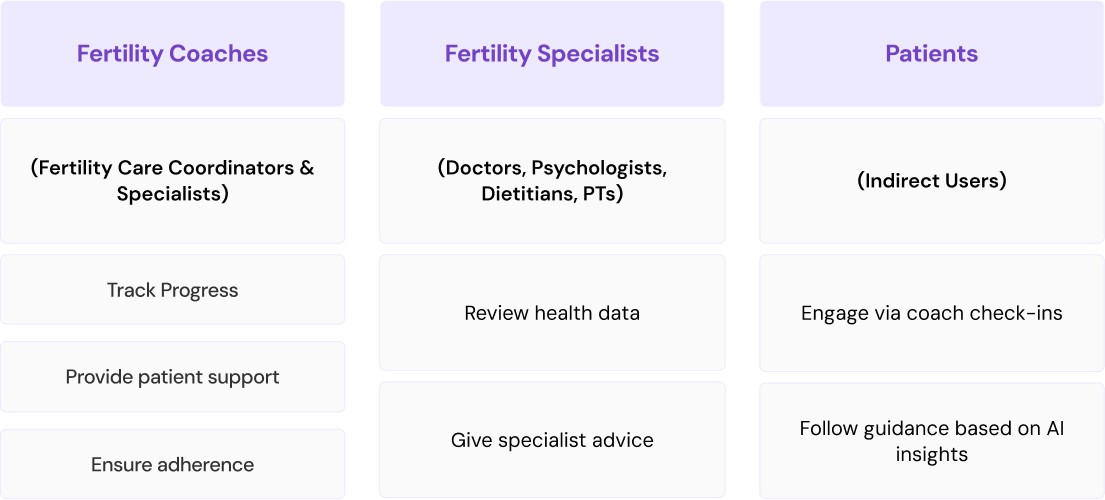
The Multi-Actor System:
Mapping responsibilities across coaches, clinicians, and patients revealed that each role required a fundamentally different view of the same system, not a single unified dashboard.
Image/
The Multi-Actor System:
Mapping responsibilities across coaches, clinicians, and patients revealed that each role required a fundamentally different view of the same system, not a single unified dashboard.
02 / The strategy
Explainability as Trust Architecture - not more Data.
Explainability as Trust Architecture - not more Data.
Explainability as Trust Architecture - not more Data.
To understand why the roadmap felt misaligned, I needed to see the care system from the inside rather than through feature requirements alone.
I mapped the full patient journey across coaches, fertility specialists, psychologists, nutritionists, and operational staff; tracing not just what happened at each stage, but where decisions slowed down, where information fragmented, and where care teams were relying on memory instead of systems. What emerged was a coordination problem.
The more I observed the workflows, the clearer it became that the proposed AI layer was adding cognitive pressure rather than reducing it. Clinicians didn’t need more information. They needed information they could trust quickly enough to act on during real consultations.
To understand why the roadmap felt misaligned, I needed to see the care system from the inside rather than through feature requirements alone.
I mapped the full patient journey across coaches, fertility specialists, psychologists, nutritionists, and operational staff; tracing not just what happened at each stage, but where decisions slowed down, where information fragmented, and where care teams were relying on memory instead of systems. What emerged was a coordination problem.
The more I observed the workflows, the clearer it became that the proposed AI layer was adding cognitive pressure rather than reducing it. Clinicians didn’t need more information. They needed information they could trust quickly enough to act on during real consultations.
To understand why the roadmap felt misaligned, I needed to see the care system from the inside rather than through feature requirements alone.
I mapped the full patient journey across coaches, fertility specialists, psychologists, nutritionists, and operational staff; tracing not just what happened at each stage, but where decisions slowed down, where information fragmented, and where care teams were relying on memory instead of systems. What emerged was a coordination problem.
The more I observed the workflows, the clearer it became that the proposed AI layer was adding cognitive pressure rather than reducing it. Clinicians didn’t need more information. They needed information they could trust quickly enough to act on during real consultations.
Understanding the Workflow Breakdown
Before redesigning the dashboard, I mapped how clinicians actually coordinated care across the fertility journey. This included workflow observations, service blueprints, clinician interviews, operational dependencies, communication flows, and escalation pathways. This revealed a critical insight: The dashboard wasn’t functioning as the operational source of truth. Instead, coordination was happening outside the system.
Understanding the Workflow Breakdown
Before redesigning the dashboard, I mapped how clinicians actually coordinated care across the fertility journey. This included workflow observations, service blueprints, clinician interviews, operational dependencies, communication flows, and escalation pathways. This revealed a critical insight: The dashboard wasn’t functioning as the operational source of truth. Instead, coordination was happening outside the system.
Understanding the Workflow Breakdown
Before redesigning the dashboard, I mapped how clinicians actually coordinated care across the fertility journey. This included workflow observations, service blueprints, clinician interviews, operational dependencies, communication flows, and escalation pathways. This revealed a critical insight: The dashboard wasn’t functioning as the operational source of truth. Instead, coordination was happening outside the system.
The Four Core Challenges
The Four Core Challenges
The Four Core Challenges
Fragmented Coordination
Critical workflows were distributed across multiple external tools, creating inconsistencies and delayed follow-ups.
Critical workflows were distributed across multiple external tools, creating inconsistencies and delayed follow-ups.
Black - Box AI
AI recommendations surfaced alerts without enough context for clinicians to confidently act on them.
AI recommendations surfaced alerts without enough context for clinicians to confidently act on them.
Cognitive Overload
The dashboard prioritized information density over decision clarity, making prioritization difficult during consultations.
The dashboard prioritized information density over decision clarity, making prioritization difficult during consultations.
Lack of Operational Ownership
Teams often couldn’t determine who should act, when action was required and what the next step should be.
This created repeated coordination loops across care teams.
Teams often couldn’t determine who should act, when action was required and what the next step should be.
This created repeated coordination loops across care teams.
Image/
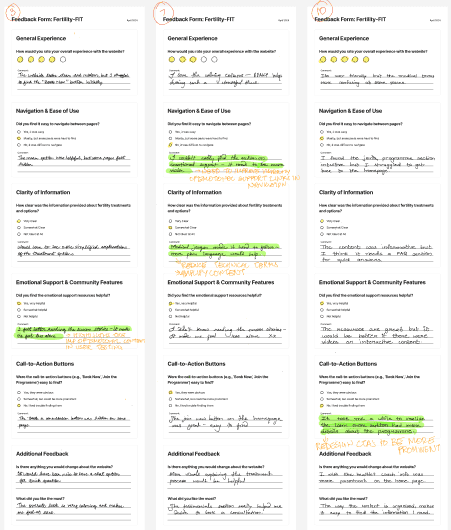
The Trust Gap Discovery:
Through contextual interviews and workflow reviews, I uncovered that clinicians were systematically ignoring AI-generated flags - not because the predictions were inaccurate, but because the system couldn’t explain why a recommendation had been surfaced. In clinical environments, unexplained intelligence creates hesitation instead of trust.
Image/
The Trust Gap Discovery:
Through contextual interviews and workflow reviews, I uncovered that clinicians were systematically ignoring AI-generated flags - not because the predictions were inaccurate, but because the system couldn’t explain why a recommendation had been surfaced. In clinical environments, unexplained intelligence creates hesitation instead of trust.
03 / The execution.
From Systems to Screens
Two Findings That Changed Everything
Two Findings That Changed Everything
Finding 1 — The Trust Gap:
Finding 1 — The Trust Gap:
Care teams were creating parallel workflows outside the platform using sticky notes, spreadsheets, WhatsApp reminders because AI alerts surfaced risk without context or next-step clarity.
Care teams were creating parallel workflows outside the platform using sticky notes, spreadsheets, WhatsApp reminders because AI alerts surfaced risk without context or next-step clarity.
Finding 2 — The Data Relevance Problem:
Finding 2 — The Data Relevance Problem:
Different specialists needed entirely different information at different moments in the care journey. A unified dashboard increased cognitive load instead of reducing it.
Different specialists needed entirely different information at different moments in the care journey. A unified dashboard increased cognitive load instead of reducing it.
Image/
Mapping the Clinical Workflow:
I used service blueprinting to trace how information moved between coaches, specialists, and patients across the fertility journey. This exposed the exact moments where the proposed dashboard would increase fragmentation, duplicate coordination work, and overload clinicians with non-actionable data.
Image/
Mapping the Clinical Workflow:
I used service blueprinting to trace how information moved between coaches, specialists, and patients across the fertility journey. This exposed the exact moments where the proposed dashboard would increase fragmentation, duplicate coordination work, and overload clinicians with non-actionable data.

02 / The strategy
By this stage, the problem was no longer designing a better dashboard interface. It was redesigning how the platform structured trust, coordination, and decision-making across multiple clinical roles.
That insight fundamentally changed both the product strategy and the visual system that followed.
By this stage, the problem was no longer designing a better dashboard interface. It was redesigning how the platform structured trust, coordination, and decision-making across multiple clinical roles.
That insight fundamentally changed both the product strategy and the visual system that followed.
By this stage, the problem was no longer designing a better dashboard interface. It was redesigning how the platform structured trust, coordination, and decision-making across multiple clinical roles.
That insight fundamentally changed both the product strategy and the visual system that followed.
03 / The execution
Redesigning Trust Across Product, Workflow, and Interface.
Redesigning Trust Across Product, Workflow, and Interface.
Redesigning Trust Across Product, Workflow, and Interface.
Redesigning Trust Across Product, Workflow, and Interface.
A. Strategic Pivot & AI Reframing
I presented the research findings to the senior stakeholder and recommended abandoning the original feature-led roadmap entirely. Instead of building a passive reporting dashboard, I reframed the product as a clinical decision-support system designed around coordination, explainability, and workflow-specific intelligence.
This was not a comfortable conversation. The original roadmap was already emotionally and strategically invested in. Rather than debating design preferences, I focused the discussion around clinical risk, trust, and operational failure points surfaced through research.
A. Strategic Pivot & AI Reframing
I presented the research findings to the senior stakeholder and recommended abandoning the original feature-led roadmap entirely. Instead of building a passive reporting dashboard, I reframed the product as a clinical decision-support system designed around coordination, explainability, and workflow-specific intelligence.
This was not a comfortable conversation. The original roadmap was already emotionally and strategically invested in. Rather than debating design preferences, I focused the discussion around clinical risk, trust, and operational failure points surfaced through research.
A. Strategic Pivot & AI Reframing
I presented the research findings to the senior stakeholder and recommended abandoning the original feature-led roadmap entirely. Instead of building a passive reporting dashboard, I reframed the product as a clinical decision-support system designed around coordination, explainability, and workflow-specific intelligence.
This was not a comfortable conversation. The original roadmap was already emotionally and strategically invested in. Rather than debating design preferences, I focused the discussion around clinical risk, trust, and operational failure points surfaced through research.
Image/
Evolving th
Image/
Evolving the Clinical Workflow:
Early explorations revealed that conventional dashboard patterns created cognitive overload, interrupted consultation flow, and buried critical actions. Through iterative testing and clinician feedback, I shifted the system from data-heavy reporting toward explainable, workflow-aware decision support.
Image/
Evolving the Clinical Workflow:
Early explorations revealed that conventional dashboard patterns created cognitive overload, interrupted consultation flow, and buried critical actions. Through iterative testing and clinician feedback, I shifted the system from data-heavy reporting toward explainable, workflow-aware decision support.

03 / The execution.
From Systems to Screens
B. Redesigning the visual system
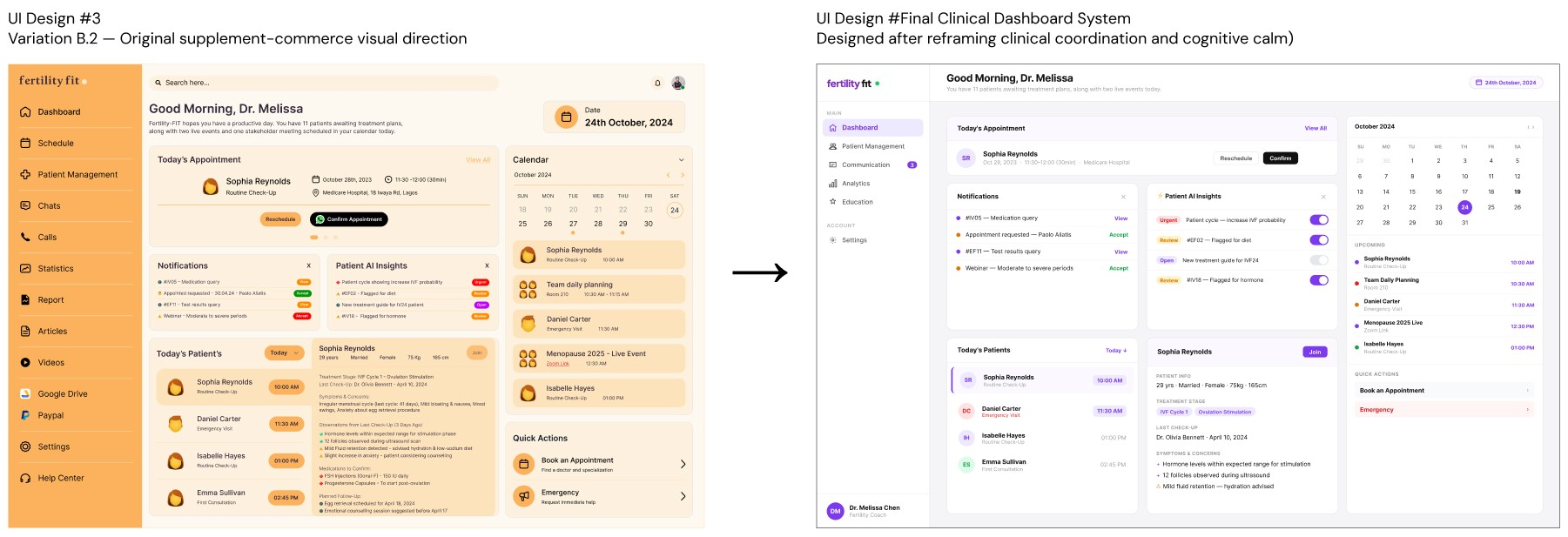
At the beginning of the project, FertilityFit still operated visually like its original supplement-focused brand. The interface used a warm orange palette designed for consumer wellness marketing rather than clinical coordination. But as the platform evolved into a multi-disciplinary fertility care system, the visual language began creating friction.
The interface needed to feel calmer, more trustworthy, and operationally structured - not promotional. The product was no longer selling supplements. It was supporting high-stakes clinical decisions across coaches, specialists, and patients.
B. Redesigning the visual system
At the beginning of the project, FertilityFit still operated visually like its original supplement-focused brand. The interface used a warm orange palette designed for consumer wellness marketing rather than clinical coordination. But as the platform evolved into a multi-disciplinary fertility care system, the visual language began creating friction.
The interface needed to feel calmer, more trustworthy, and operationally structured - not promotional. The product was no longer selling supplements. It was supporting high-stakes clinical decisions across coaches, specialists, and patients.
B. Redesigning the visual system
At the beginning of the project, FertilityFit still operated visually like its original supplement-focused brand. The interface used a warm orange palette designed for consumer wellness marketing rather than clinical coordination. But as the platform evolved into a multi-disciplinary fertility care system, the visual language began creating friction.
The interface needed to feel calmer, more trustworthy, and operationally structured - not promotional. The product was no longer selling supplements. It was supporting high-stakes clinical decisions across coaches, specialists, and patients.
The Branding Collaboration:
The Branding Collaboration:
I worked closely with the mid-weight designer leading the broader brand identity to rethink how FertilityFit should visually position itself inside the larger AdeaHealth ecosystem.
Together, we audited the existing interface system, interaction patterns, accessibility contrast levels, and emotional perception of the product across different user roles. Through internal reviews and workflow testing sessions, it became clear that the existing visual direction amplified urgency and visual noise rather than supporting focus and clinical clarity.
I worked closely with the mid-weight designer leading the broader brand identity to rethink how FertilityFit should visually position itself inside the larger AdeaHealth ecosystem.
Together, we audited the existing interface system, interaction patterns, accessibility contrast levels, and emotional perception of the product across different user roles. Through internal reviews and workflow testing sessions, it became clear that the existing visual direction amplified urgency and visual noise rather than supporting focus and clinical clarity.
The Color-System Decision:
The Color-System Decision:
We transitioned the platform from a high-energy orange system into a more restrained purple-based visual language designed around trust, cognitive calmness, and information hierarchy. The change wasn’t aesthetic rebranding alone. It fundamentally changed how the product behaved.
The new system introduced:
clearer visual prioritisation
calmer interaction states
reduced alert fatigue
stronger contrast between informational and actionable elements
more scalable component behaviour across dashboards, tables, and AI states
As the platform expanded beyond supplements into AI-assisted fertility coordination, the visual system needed to communicate medical credibility without feeling cold or institutional.
We transitioned the platform from a high-energy orange system into a more restrained purple-based visual language designed around trust, cognitive calmness, and information hierarchy. The change wasn’t aesthetic rebranding alone. It fundamentally changed how the product behaved.
The new system introduced:
clearer visual prioritisation
calmer interaction states
reduced alert fatigue
stronger contrast between informational and actionable elements
more scalable component behaviour across dashboards, tables, and AI states
As the platform expanded beyond supplements into AI-assisted fertility coordination, the visual system needed to communicate medical credibility without feeling cold or institutional.
Image/
Evolving th
Image/
From Wellness Brand to Clinical Platform::
The original visual system reflected FertilityFit’s supplement-commerce origins. As the product evolved into an AI-assisted clinical coordination platform, I redesigned the interface system to prioritise trust, clarity, and scalable workflow management across multiple specialist roles.
Image/
From Wellness Brand to Clinical Platform:
The original visual system reflected FertilityFit’s supplement-commerce origins. As the product evolved into an AI-assisted clinical coordination platform, I redesigned the interface system to prioritise trust, clarity, and scalable workflow management across multiple specialist roles.
Image/
From Welln
The redesign also became the foundation for a broader component system shared across future AdeaHealth products. Tables, cards, alert states, and interaction behaviours were rebuilt to scale consistently across expanding healthcare workflows rather than isolated product screens.
The redesign also became the foundation for a broader component system shared across future AdeaHealth products. Tables, cards, alert states, and interaction behaviours were rebuilt to scale consistently across expanding healthcare workflows rather than isolated product screens.
The redesign also became the foundation for a broader component system shared across future AdeaHealth products. Tables, cards, alert states, and interaction behaviours were rebuilt to scale consistently across expanding healthcare workflows rather than isolated product screens.
03 / The execution.
From Systems to Screens
C. Role-based Information Architecture
Once the product direction and visual system were reframed, I redesigned the information architecture around how each role actually worked inside the fertility journey.
Rather than exposing a single unified dashboard, the system adapted visibility, priority, and interaction patterns based on the cognitive needs of each user group.
Same ecosystem. Different operational lenses.
C. Role-based Information Architecture
Once the product direction and visual system were reframed, I redesigned the information architecture around how each role actually worked inside the fertility journey.
Rather than exposing a single unified dashboard, the system adapted visibility, priority, and interaction patterns based on the cognitive needs of each user group.
Same ecosystem. Different operational lenses.
C. Role-based Information Architecture
Once the product direction and visual system were reframed, I redesigned the information architecture around how each role actually worked inside the fertility journey.
Rather than exposing a single unified dashboard, the system adapted visibility, priority, and interaction patterns based on the cognitive needs of each user group.
Same ecosystem. Different operational lenses.
Explainability as Trust Infrastructure:
Explainability as Trust Infrastructure:
A flag now reads not as a risk score but as a clinical prompt: "Hormone levels dropping - review cycle 3 data." This is the difference between a black-box alert and a clinical decision-support tool.
A flag now reads not as a risk score but as a clinical prompt: "Hormone levels dropping - review cycle 3 data." This is the difference between a black-box alert and a clinical decision-support tool.
The Architectural Consequence:
The Architectural Consequence:
This single decision made the AI layer usable. Coaches who had been reverting to sticky notes began using the system as their primary coordination tool. The dashboard moved from something people worked around to something they worked within.
This single decision made the AI layer usable. Coaches who had been reverting to sticky notes began using the system as their primary coordination tool. The dashboard moved from something people worked around to something they worked within.
Image/
Evolving th
Image/
The Clinician's Morning View:
Designed around a single question: what do I need to act on today? rather than what data can we show. Appointments, AI alerts, and patient priorities surface in clinical sequence, not data hierarchy.
Image/
The Clinician's Morning View:
Designed around a single question: what do I need to act on today? rather than what data can we show. Appointments, AI alerts, and patient priorities surface in clinical sequence, not data hierarchy.

Image/
Evolving th
Image/
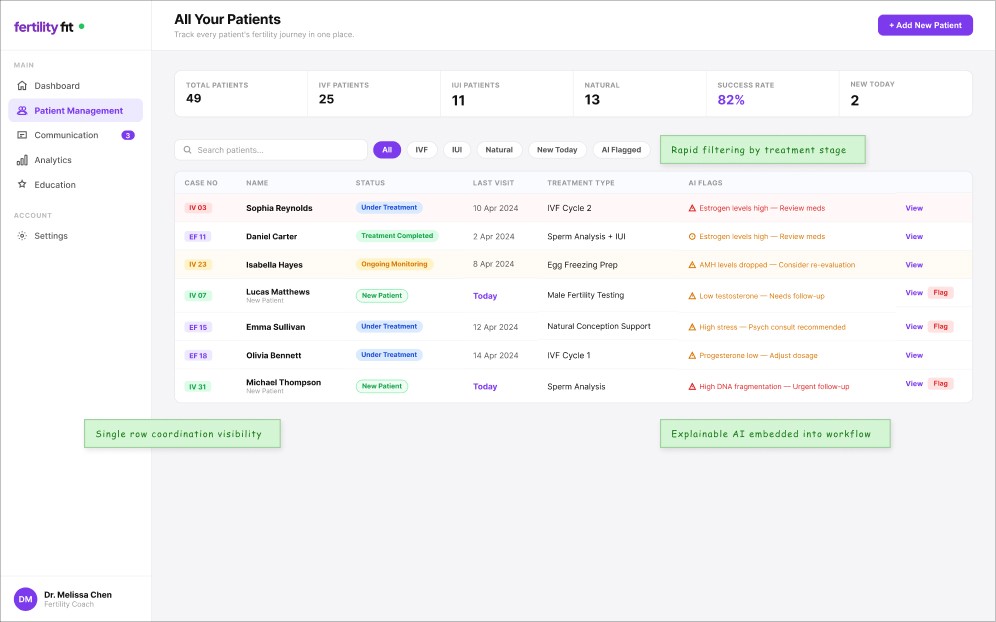
The Coordination Layer:
The patient management view was designed for the coach's primary job: never losing track of where a patient is in their treatment journey. AI flags, treatment stage, and last visit visible in a single scannable row.
Image/
The Coordination Layer:
The patient management view was designed for the coach's primary job: never losing track of where a patient is in their treatment journey. AI flags, treatment stage, and last visit visible in a single scannable row.
Image/
Evolving th
Image/
Designing for Decision-Making at Different Scales:
The statistics and reports view was designed for practice-level decisions - not individual case management. Success rates, adherence trends, and downloadable reports give the practice director a strategic view without cluttering the clinical workflow.
Image/
Designing for Decision-Making at Different Scales:
The statistics and reports view was designed for practice-level decisions - not individual case management. Success rates, adherence trends, and downloadable reports give the practice director a strategic view without cluttering the clinical workflow.

03 / The execution.
From Systems to Screens
D. Explainable Alerts and Clinical Trust
The most consequential design decision in this project wasn’t visual. It was architectural.
I worked directly with the data team to redesign how AI outputs were structured and surfaced inside the workflow. Instead of displaying isolated probability scores, every alert carried the clinical reasoning behind the recommendation — the “why” behind the signal.
D. Explainable Alerts and Clinical Trust
The most consequential design decision in this project wasn’t visual. It was architectural.
I worked directly with the data team to redesign how AI outputs were structured and surfaced inside the workflow. Instead of displaying isolated probability scores, every alert carried the clinical reasoning behind the recommendation — the “why” behind the signal.
D. Explainable Alerts and Clinical Trust
The most consequential design decision in this project wasn’t visual. It was architectural.
I worked directly with the data team to redesign how AI outputs were structured and surfaced inside the workflow. Instead of displaying isolated probability scores, every alert carried the clinical reasoning behind the recommendation — the “why” behind the signal.
Image/
Designing Explainable Clinical Systems:
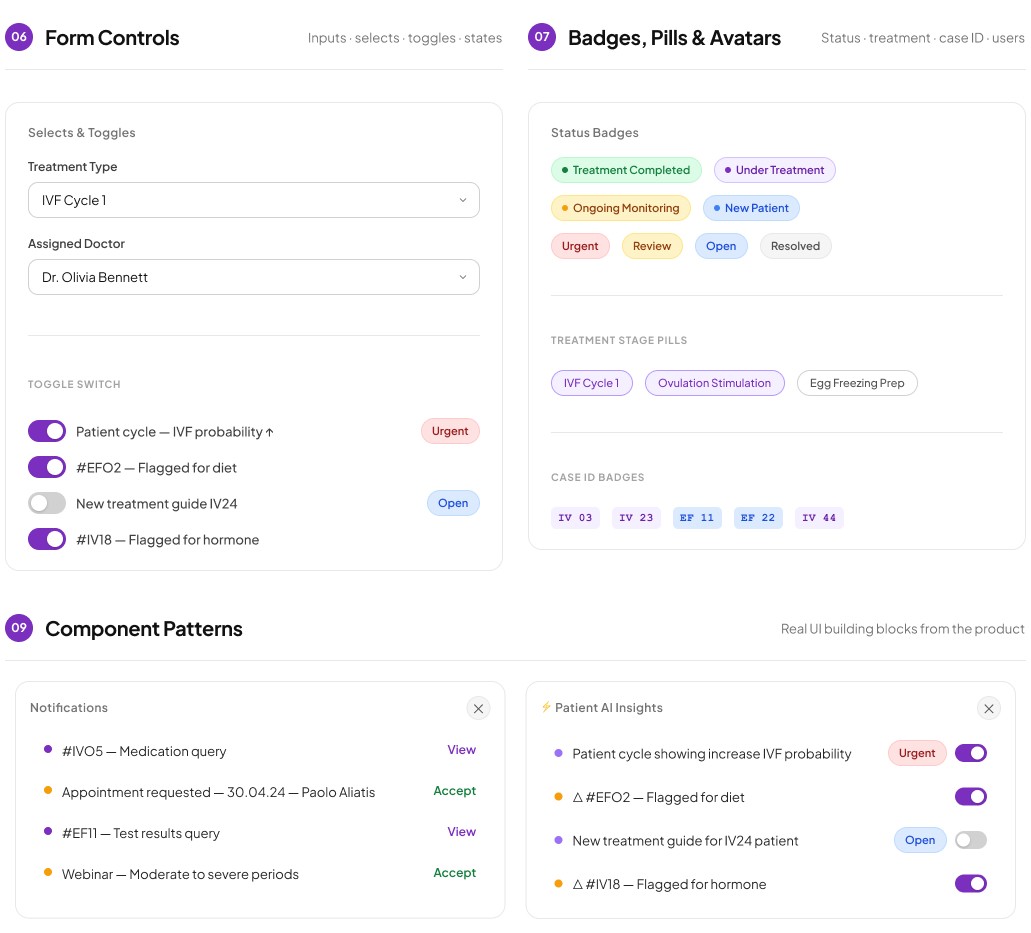
AI outputs were redesigned as actionable clinical prompts rather than isolated probability scores. Alerts, badges, toggles, and notification states were built to support rapid scanning, reduce alert fatigue, and scale consistently across workflows.
Image/
Designing Explainable Clinical Systems:
AI outputs were redesigned as actionable clinical prompts rather than isolated probability scores. Alerts, badges, toggles, and notification states were built to support rapid scanning, reduce alert fatigue, and scale consistently across workflows.
Image/
Role-Oriented Navigation Architecture:
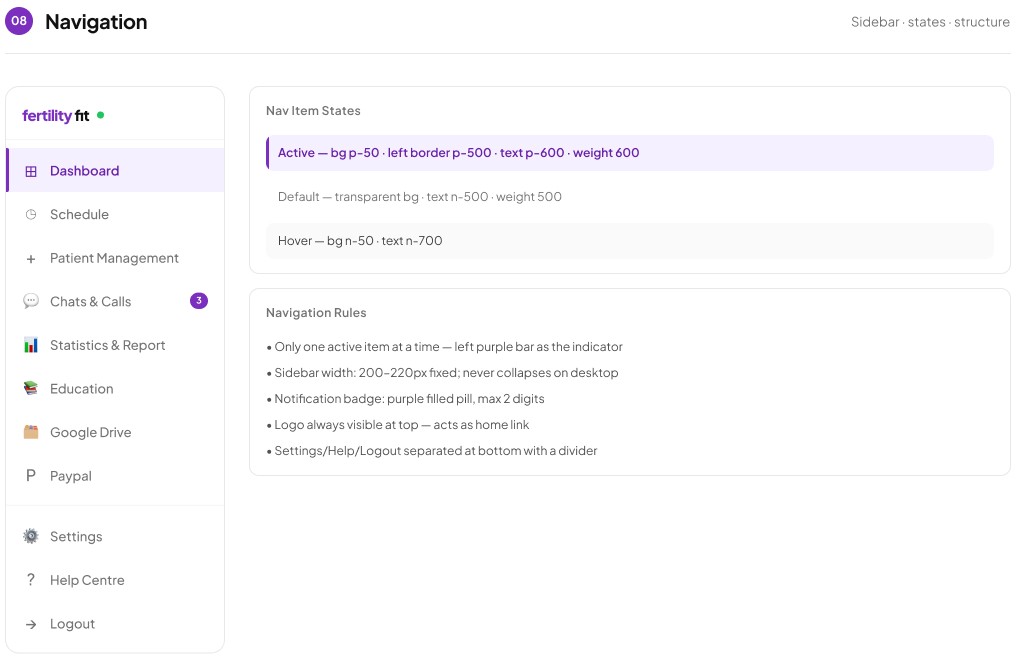
Navigation was structured around operational workflows rather than feature grouping, helping clinicians move quickly between coordination, reporting, and patient management with minimal cognitive switching.
Image/
Role-Oriented Navigation Architecture:
Navigation was structured around operational workflows rather than feature grouping, helping clinicians move quickly between coordination, reporting, and patient management with minimal cognitive switching.
04 /
The impact and results.
The impact and results.
The impact and results.
The impact and results.
↓ 30%
Reduction in Manual Coordination
Care teams moved from fragmented spreadsheets, sticky notes, and WhatsApp reminders into a single coordinated operational workflow.
40% → 85%
Increase in AI Recommendation Adoption
Explainable alerts transformed AI recommendations from passive notifications into clinically actionable guidance.
3x Faster
Specialist Coordination & Follow-Ups
Clear ownership visibility, prioritization, and contextual next-step guidance reduced delays across fertility care workflows.
Foundation for Scale
The operational framework and shared interaction logic became the foundation for future workflow expansion across additional fertility pathways and specialist roles.
↓ 30%
Reduction in Manual Coordination
Care teams moved from fragmented spreadsheets, sticky notes, and WhatsApp reminders into a single coordinated operational workflow.
40% → 85%
Increase in AI Recommendation Adoption
Explainable alerts transformed AI recommendations from passive notifications into clinically actionable guidance.
3x Faster
Specialist Coordination & Follow-Ups
Clear ownership visibility, prioritization, and contextual next-step guidance reduced delays across fertility care workflows.
Foundation for Scale
The operational framework and shared interaction logic became the foundation for future workflow expansion across additional fertility pathways and specialist roles.
05 /
Reflections.
Reflections.
Reflections.
Reflections.
Context is more valuable than volume.
Context is more valuable than volume.
The most dangerous clinical dashboard isn’t one that shows too little. It’s one that creates false confidence through unexplained information.
Every workflow decision in this project was tested against one question: Does this help clinicians confidently act, or does it simply give them more data to process?
That distinction ultimately shaped the entire system.
The most dangerous clinical dashboard isn’t one that shows too little. It’s one that creates false confidence through unexplained information.
Every workflow decision in this project was tested against one question: Does this help clinicians confidently act, or does it simply give them more data to process?
That distinction ultimately shaped the entire system.
Research defines the product direction.
Research defines the product direction.
The most important breakthrough happened before a single interface was redesigned. Workflow observations and contextual interviews revealed that clinicians weren’t rejecting AI itself - they were rejecting unclear operational guidance. That insight completely changed the direction of the platform.
This project reinforced an important principle I now bring into every system: Good operational design isn’t about surfacing more information.
It’s about helping people understand what matters, why it matters, and what should happen next.
The most important breakthrough happened before a single interface was redesigned. Workflow observations and contextual interviews revealed that clinicians weren’t rejecting AI itself - they were rejecting unclear operational guidance. That insight completely changed the direction of the platform.
This project reinforced an important principle I now bring into every system: Good operational design isn’t about surfacing more information.
It’s about helping people understand what matters, why it matters, and what should happen next.
06 / What’s Next
Scaling the vision.
Scaling the vision.
Scaling the vision.
Scaling the vision.
Expanding Role-Based Views.
As AdeaHealth scales into new health conditions, the role-based architecture built for FertilityFit provides the modular foundation for rapid clinical expansion without rebuilding information hierarchies from scratch.
Deepening AI Explainability.
The next layer of the explainable alert system involves surfacing longitudinal trend data, not just what changed, but how it has changed over multiple cycles , giving clinicians pattern-level intelligence rather than point-in-time flags.
Patient-Facing Transparency.
Bringing the same explainability principle to the patient experience, so that patients understand not just their treatment status, but the clinical reasoning behind each recommendation in their care plan.
Expanding Role-Based Views.
As AdeaHealth scales into new health conditions, the role-based architecture built for FertilityFit provides the modular foundation for rapid clinical expansion without rebuilding information hierarchies from scratch.
Deepening AI Explainability.
The next layer of the explainable alert system involves surfacing longitudinal trend data, not just what changed, but how it has changed over multiple cycles , giving clinicians pattern-level intelligence rather than point-in-time flags.
Patient-Facing Transparency.
Bringing the same explainability principle to the patient experience, so that patients understand not just their treatment status, but the clinical reasoning behind each recommendation in their care plan.
Expanding Role-Based Views.
As AdeaHealth scales into new health conditions, the role-based architecture built for FertilityFit provides the modular foundation for rapid clinical expansion without rebuilding information hierarchies from scratch.
Deepening AI Explainability.
The next layer of the explainable alert system involves surfacing longitudinal trend data, not just what changed, but how it has changed over multiple cycles , giving clinicians pattern-level intelligence rather than point-in-time flags.
Patient-Facing Transparency.
Bringing the same explainability principle to the patient experience, so that patients understand not just their treatment status, but the clinical reasoning behind each recommendation in their care plan.

Next Project
AdeaHealth
AdeaHealth
AdeaHealth
View Case Study
View Case Study
Orchestrating Care at Scale: The Design System Behind AdeaHealth's Global Expansion
Orchestrating Care at Scale: The Design System Behind AdeaHealth's Global Expansion
Orchestrating Care at Scale: The Design System Behind AdeaHealth's Global Expansion
Orchestrating Care at Scale: The Design System Behind AdeaHealth's Global Expansion
Led end-to-end service and product design for a multi-condition health platform, mapping invisible handoffs between patients, clinicians, and partners into a system that actually holds together.
Led end-to-end service and product design for a multi-condition health platform, mapping invisible handoffs between patients, clinicians, and partners into a system that actually holds together.
Led end-to-end service and product design for a multi-condition health platform, mapping invisible handoffs between patients, clinicians, and partners into a system that actually holds together.
Led end-to-end service and product design for a multi-condition health platform, mapping invisible handoffs between patients, clinicians, and partners into a system that actually holds together.

/ Namaste
Say hello.
Say hello.
Say hello.
I'm currently open to Senior Product and Service Designer roles across the EU and UK (remote, hybrid, or on-site). I’m especially interested in scale-ups building complex SaaS, healthcare, fintech, AI, or data-heavy products where design needs to bring clarity across users, teams, and systems.
I'm currently open to Senior Product and Service Designer roles across the EU and UK (remote, hybrid, or on-site). I’m especially interested in scale-ups building complex SaaS, healthcare, fintech, AI, or data-heavy products where design needs to bring clarity across users, teams, and systems.
I'm currently open to Senior Product and Service Designer roles across the EU and UK (remote, hybrid, or on-site). I’m especially interested in scale-ups building complex SaaS, healthcare, fintech, AI, or data-heavy products where design needs to bring clarity across users, teams, and systems.
Work Rights
Work Rights
EU Passport · UK Settled Status · No sponsorship needed
EU Passport · UK Settled Status · No sponsorship needed
Work Rights
EU Passport · UK Settled Status · No sponsorship needed
Availability
Availability
1-month notice · Open to remote, hybrid, or on-site anywhere in the EU
1-month notice · Open to remote, hybrid, or on-site anywhere in the EU
Availability
1-month notice · Open to remote, hybrid, or on-site anywhere in the EU
Navigation.
Navigation.
Navigation.
copyright 2026 by saloni tangal
copyright 2026 by saloni tangal
/ Namaste
Say hello.
I'm currently open to Senior Product and Service Designer roles across the EU and UK (remote, hybrid, or on-site). I’m especially interested in scale-ups building complex SaaS, healthcare, fintech, AI, or data-heavy products where design needs to bring clarity across users, teams, and systems.
Email/
saloni.designequation@gmail.com
Linkedin/
linkedin.com/in/saloni-tangal/
Medium/
medium.com/@saloni.designequation
Work Rights
EU Passport · UK Settled Status · No sponsorship needed
Availability
1-month notice · Open to remote, hybrid, or on-site anywhere in the EU
Navigation.
copyright 2026 by saloni tangal