

PAYLIO
01 / The challenge
02 / The strategy
Structural Baselines:
Image/
First AI-generated wireframe set using Stitch Design and Second AI-generated wireframe set using Lovable AI
Strategic Nuance:
Image/
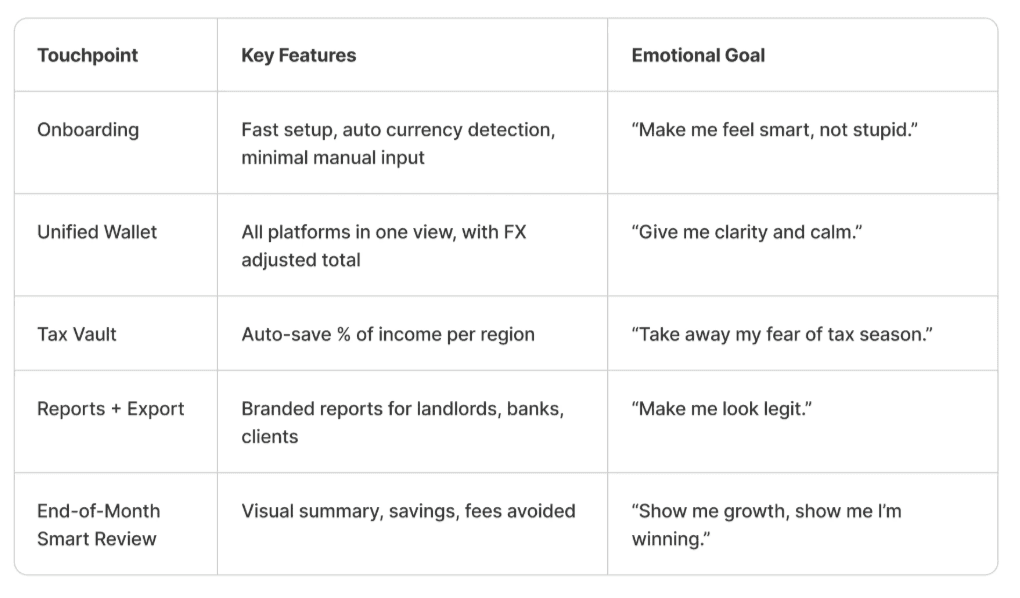
Built a Prioritised Feature Bucket Table with:
Touchpoint (where in the journey the feature appears)
Key Features (functional role in MVP)
Emotional Goal (how it should feel for the user)
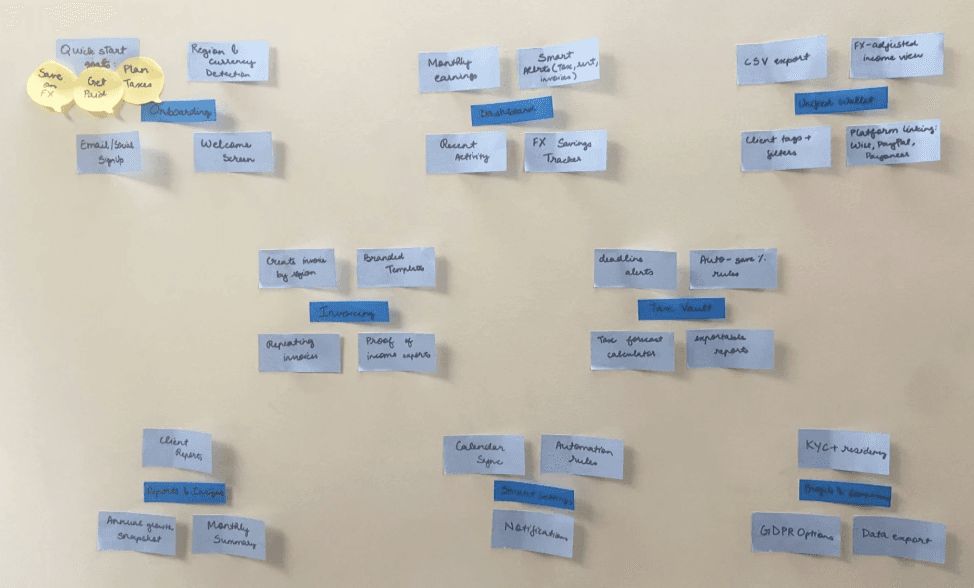
Initial sitemap and IA to map flows from onboarding through income aggregation, FX optimisation, tax handling, and proof generation. This step revealed the main structural issue: without feature hierarchy, AI-generated flows risked becoming feature-dumps rather than coherent journeys.
Image/
Designing Complex UX Without a Backend
To validate Paylio’s compliance logic before development, I embedded key decision flows into the user flow (see highlights) and distilled them into three guiding UX artifacts:
Compliance Logic Cheat-Sheet – Static table mapping base country, client country, and VAT status to the correct rate and rule label.
Tax Outcome Card – Dashboard element showing tax % and amount, applied rule, and a download link for invoice + proof.
Decision Flow Mini-Diagram – Profile → Invoice → Rule applied → Outcome → Download proof.
These artifacts kept onboarding, invoicing, and reporting flows consistent and ready for backend alignment — without needing a live database.

Iterative Refinement:
Image/
Third and Eighth AI-generated wireframe after optimizing the previous prompts using Loveable AI.
The outputs went from bare wireframes → mid-fidelity layouts with better structure, spacing, and interaction hints.


Industry Recognition:
03 / The execution
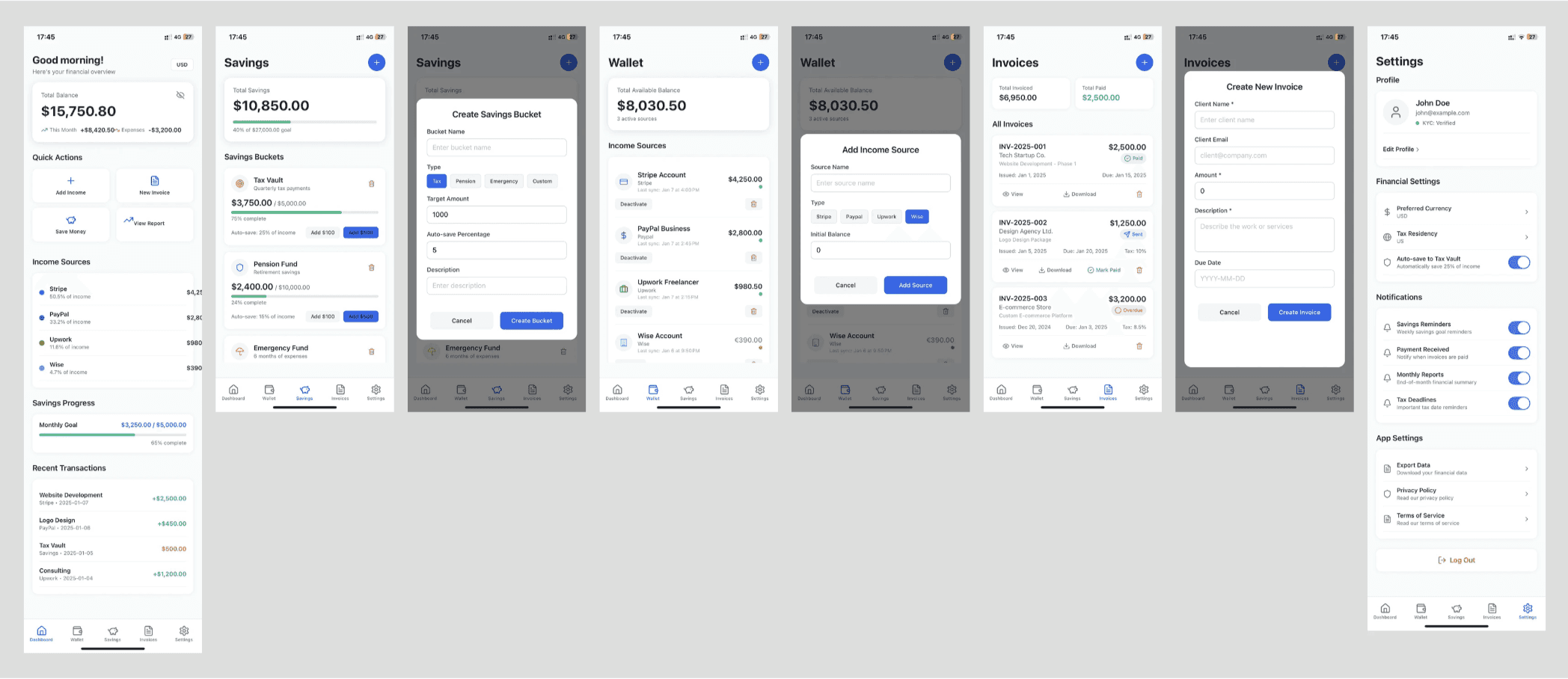
⚡ The "Actionable Insights" Hub:
Quick actions and recent transactions are prioritized to allow freelancers to manage their financial life in under 60 seconds.
Interactivity:
Every card is a gateway; users can dive deep into specific income sources or savings buckets with a single tap.
Image/
The Financial Cockpit:
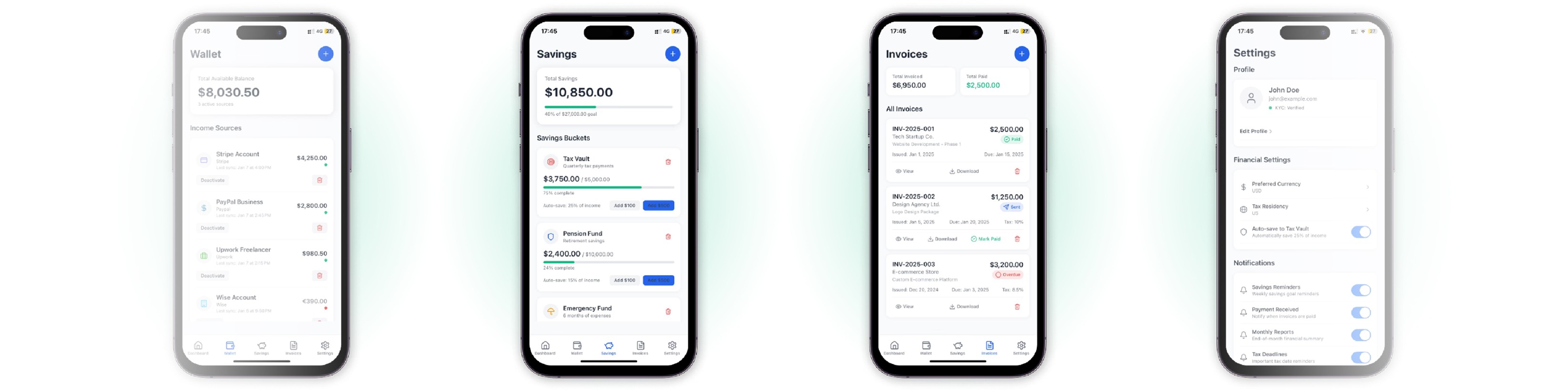
The final dashboard replaces financial chaos with a "Calm Command Center." I prioritized data density and readability, allowing freelancers to monitor global income in one normalized view.
Financial Goal Setting:
Targeted savings buckets (Tax Vault, Pension, Emergency Fund) with automated progress tracking.
Smart Invoicing:
A streamlined creation flow that embeds regional compliance and payment status tracking.
Wallet Management:
Real-time visibility into multiple accounts, from traditional banks like Wise to digital platforms like Upwork.
04 / What's next
Design System Maturity:
Finalizing a high-fidelity system tailored to Paylio’s "Calm UI" visual brand.
User Validation:
Integrating direct usability feedback from independent professionals across Spain, Portugal, and Estonia.
Tactile Feedback:
Building and testing microinteractions for high-stakes "money flows" to increase user confidence.
Global Expansion:
Scaling compliance intelligence to support non-EU freelancers collaborating with EU-based clients.
Time Efficiency:
A projected 40% reduction in time spent on income and tax administration through automated aggregation.
Profit Recovery:
Saving 15–25% in currency conversion losses via optimized FX routing.
Compliance Confidence:
Reducing late filing and errors by automating regional VAT and tax requirements.
Institutional Access:
Accelerating approvals for housing, visas, and loans with instant, verifiable financial proof.
05 /
"Complexity ≠ Clutter"
Trust is a UX Deliverable:
For an independent professional, financial visibility and compliance proof are the foundations of credibility.
AI as a Co-Pilot, Not Autopilot:
Using tools like Lovable and Stitch accelerated exploration by 3x, but human-centered design was required to fix the "nuance gaps" in AI-generated flows.
Designing for Buildability:
By delivering a "Compliance Logic Cheat-Sheet" alongside the UI, I ensured the backend logic for VAT and FX was mirrored perfectly in the final user experience.

Next Project

